 Proudly Serving Allentown, Bethlehem, Easton & the Lehigh Valley
 ISA Certified Arborists
 Fully Insured

 (484) 225-8400


Tree Trimming in
Bethlehem, PA
Tree trimming in Bethlehem, PA. Thrive Tree handles
structural pruning and hillside canopy work
on South Side and North Side properties.
A Tree on a Slope Accumulates Risk Differently Than One on Flat Ground
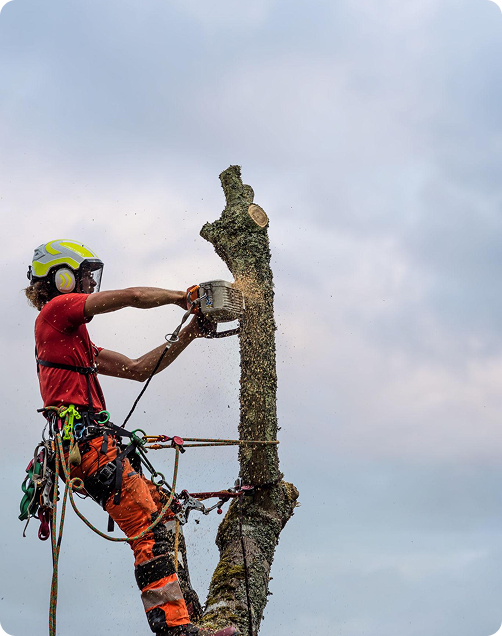
Tree trimming on Bethlehem’s hillside residential streets isn’t the same job it is on a flat lot. A Norway maple growing on a grade above the South Side between Fifth and Seventh Avenues develops a crown that compensates for the slope, heavier on the uphill side, extending further downhill where the lean is less resisted. The standard read of crown weight from street level doesn’t account for that distribution. A scaffold branch that looks like a minor trimming item from the sidewalk may be carrying disproportionate lateral load when you’re inside the crown. Tree trimming on those properties requires that read before the first cut, not after.
The North Side carries a different backlog. The blocks near Monocacy Creek and the older residential streets around the Lehigh University corridor still have mature oaks, ashes with partial EAB dieback, and ornamentals planted when those neighborhoods were at peak density. Most haven’t seen systematic trimming work in years. The deadwood accumulation in those crowns is the kind that comes down during a storm rather than on a schedule, which is exactly the problem tree trimming is supposed to prevent.

Professional Tree Trimming in Bethlehem, PA
The first question on any Bethlehem trimming job is what the tree actually needs rather than what it looks like from the ground. A Norway maple on the South Side that was topped by a previous crew isn’t a candidate for another reduction pass. It’s carrying weakly attached epicormic regrowth at every old cut point, and what it needs is a structural assessment and a targeted thinning that removes the worst of that regrowth without triggering another flush. An ash on the North Side with partial EAB dieback needs a different conversation entirely. Tree trimming in Bethlehem covers a wide range of conditions and the approach has to match the specific tree, not a default service package
On the hillside properties above the South Side, clearance pruning takes on a dimension it doesn’t have on flat lots. A branch that clears the gutter of a rowhouse on Wyandotte Street may be pressing against the wall of the house directly above it on the terraced lot uphill. Getting complete clearance often requires coordinating with both properties, and the contact points on a sloped site aren’t always visible from one vantage point. A climber inside the crown working the hillside side of a tree sees problems that a ground-level walk-around misses entirely.
Certified Local Arborists
Norway maple dominates the South Side’s residential canopy in a way that makes species-specific knowledge directly consequential. The species responds poorly to heavy pruning: dense epicormic regrowth clusters at the wound sites, the regrowth is weakly attached, and within a few growing seasons the crown is denser and structurally worse than it was before the work. Certified arborist training covers the pruning response patterns that determine where cuts get made on a Norway maple, and on the South Side blocks where nearly every yard has one, that knowledge is in use on nearly every job.
The hillside properties between the South Side and the ridge above Linden Street require a climber who reads slope. The attachment angle of a scaffold branch on a tree growing on a grade looks different from inside the crown than it does from the street. The load distribution on a co-dominant stem union is affected by how the tree has compensated for the slope over decades. These are the details that determine whether a branch is a trim item or a removal candidate, and they require being in the tree to assess correctly.
Bethlehem Tree Trimming Experts
Most Bethlehem trimming calls come from one of two situations. A South Side homeowner on a terraced lot whose Norway maple has been growing for thirty years and has never had anyone inside the crown, and who just got a complaint from a neighbor on the uphill or downhill side, because on those lots the crown sits in someone else’s airspace regardless of which direction it grows. Or a North Side homeowner with a mature oak or maple from the Steel era that they’ve been watching get larger every year and want assessed before it becomes a removal conversation instead of a trimming one. Neither of those calls comes from someone doing routine maintenance. Both come from someone who waited until the situation announced itself.
Spring and post-storm windows book fast city-wide. Calling in late summer or early fall for winter work is the most reliable way to get a scheduled window. Winter trimming on Bethlehem’s hillside properties has a practical advantage: the ground is firmer, which makes positioning equipment on a grade safer and causes less damage to any turf or hardscape along the access path.
Complete Tree Trimming Services for
Bethlehem Properties
Thrive Tree handles tree trimming across Bethlehem’s full range of site conditions, from routine
deadwood removal on North Side residential maples to structural intervention on the
hillside canopy above the South Side where slope changes the calculation on every cut.
Crown Reduction
Takes height and spread out of a tree that has outgrown its site without destroying its structure. On the South Side, Norway maples that have been growing unchecked for decades often press simultaneously into neighboring properties on multiple sides on the narrow attached lots common between Fourth and Eighth Avenues. Reduction cuts go to lateral branches capable of carrying the remaining crown. Cutting to stubs creates decay and worse regrowth. The goal is a smaller crown that stays structurally sound.
Deadwood and Hazard Branch Removal
The highest-priority trimming work on any established Bethlehem property. On the North Side near Monocacy Creek, mature oaks and partially EAB-compromised ashes carry dead scaffold branches that represent a predictable failure event during any significant wind or ice loading. Removing that deadwood on a schedule is cheaper and less disruptive than removing it from a car or a roof after the fact.
Clearance Pruning
Clearance work on Bethlehem’s hillside properties requires accounting for contact points that aren’t visible from one direction. A tree growing on a grade between two terraced lots may be clearing the lower structure while pressing against the upper one. Identifying all the contact points requires a full site walk and a climber’s view from inside the crown, not a street-level assessment. Clearance pruning on these sites is more time-intensive than flat-lot work of the same apparent scope.
Structural Pruning
The South Side’s dominant species requires a specific approach. Heavy cuts trigger the epicormic regrowth response that makes Norway maple a recurring maintenance problem when it’s trimmed incorrectly. Correct work on these trees involves reduction and thinning cuts made to meaningful lateral branches, removing the dense interior canopy that accumulates ice load, and leaving a crown that is structurally sound rather than just temporarily smaller.
Dead Wood Removal
Ashes with partial EAB dieback on the North Side still standing need a clear-eyed assessment before any trimming proceeds. How much live crown remains, how structurally sound the trunk is, and whether the tree has a realistic path forward or is a staged removal candidate are the questions that determine what trimming, if any, makes sense. Removing deadwood from a tree that is going to need full removal in two years is a different conversation than maintaining a tree with significant live crown still intact.
FREQUENTLY ASKED QUESTIONS
Hillside properties on the South Side cost more to trim than flat-lot jobs of the same tree size, and the difference is real. Slope assessment, the time required to read crown load distribution correctly on a grade, and the slower pace of clearance work on terraced lots all add time beyond what tree size alone predicts. Norway maple reduction on a tight South Side block where the crown is pressing into multiple neighboring properties adds further complexity. An in-person estimate at the Bethlehem property is the only honest number.
Most established trees benefit from assessment every three to five years. Norway maples on the South Side, which grow fast and accumulate dense canopy, often warrant attention on the shorter end of that range. Ashes on the North Side with active or recent EAB pressure need more frequent assessment regardless of visible crown condition, since structural integrity can deteriorate faster than external symptoms suggest. The actual interval depends on species, site conditions, and what the previous round of work addressed.
Late winter is the clearest structural window: bare canopy, visible branch architecture, and cuts made just before spring growth push heal efficiently. On Bethlehem’s hillside properties, late winter and winter work also has a practical equipment advantage: frozen ground holds machinery better on a grade than wet spring soil does, and causes less damage to turf and hardscape along the access path. Summer works for deadwood and clearance work where contact points are easier to identify with foliage present.
Yes, but only with the right approach. Norway maple produces dense, weakly attached epicormic regrowth at heavy cut points. That regrowth looks like recovery and isn’t. Correct pruning on Norway maple goes to lateral branches of meaningful size, removes the dense interior canopy that accumulates ice and wind load, and avoids the topping and stub-cutting that turns a manageable tree into a permanent maintenance problem. On the South Side blocks where Norway maple is the dominant species, this distinction matters on nearly every trimming job.
Trimming on private property trees in Bethlehem generally doesn’t require a permit. Street trees in the public right-of-way fall under city jurisdiction. For properties within the North Side historic district around Church Street and the Moravian settlement area, significant pruning work on trees visible from public rights-of-way may require review coordination with the city’s historic preservation office. The boundary isn’t always obvious from the street. Confirming whether a property falls within the overlay before scheduling avoids delays on the day of the job.
Trimming removes deadwood and reduces load on whatever live crown remains, which buys time and reduces the immediate hazard from failing branches. It does not address the underlying EAB infestation. A Bethlehem ash with significant EAB dieback needs an assessment that answers two questions: how much structural integrity remains in the trunk, and whether the live crown is sufficient to justify treatment costs versus planning a staged removal. Trimming alone on a heavily compromised ash is a maintenance decision, not a survival strategy.
GET STARTED TODAY
YOUR TREES DESERVE
EXPERT ATTENTION
Don’t wait until a hazard becomes a headline. Call Thrive
Homes today for a free, no-obligation estimate
from your local certified arborists.
 (484) 225-8400

FULLY LICENSED
& INSURED

CERTIFIED
ARBORISTS

SAFE, RELIABLE
& PROFESSIONAL
