 Proudly Serving Allentown, Bethlehem, Easton & the Lehigh Valley
 ISA Certified Arborists
 Fully Insured

 (484) 225-8400


Tree Trimming in
Forks Township, PA
Tree trimming in Forks Township, PA. Thrive Tree handles
subdivision canopy, Bushkill Creek riparian trees,
and Sullivan Trail corridor lots.
The Trees Going In During the Build-Out Are Now Old Enough to Need Real Work
Most of the trees on Forks Township subdivision lots have never been structurally assessed. The developer-planted silver maples, ornamental cherries, and Norway maples that came with the subdivision homes are now fifteen to twenty-five years old. At that age the formative window has closed. The competing leaders that should have been addressed at eight feet are now at thirty. The scaffold branches that were thin and flexible when the house sold are now carrying real load against neighboring structures. Structural pruning at this stage is harder and more consequential than it would have been a decade ago. The case for acting now is that the same work will be even harder a decade from now.
The older lots along Sullivan Trail and the Kesslersville and Uhler Road corridors carry more mature canopy from agricultural-era plantings. Different species, different age, different problems. The Bushkill Creek corridor runs through the northern sections of the township with tree conditions shaped by riparian soil and periodic flooding. Each situation calls for a different read.

Professional Tree Trimming in
Forks Township, PA
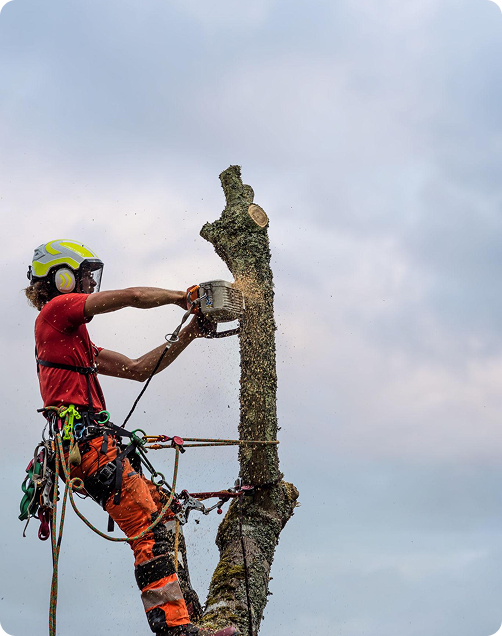
The most common trimming failure on Forks Township subdivision lots is working from the ground rather than from inside the crown. A silver maple with a co-dominant stem that has been developing included bark for fifteen years doesn’t announce itself from the sidewalk. The load on the weaker stem, the extent of the bark inclusion, the scaffold branches most likely to fail under ice load. Those are the cuts that matter, and finding them requires being inside the canopy. A crew that clears the obvious deadwood and calls it done has addressed the visible problem and missed the structural one.
Norway maple in the older subdivision lots requires species-specific handling. Heavy cuts at stub points trigger dense epicormic regrowth, weakly attached and structurally worse than what was there before. Correct work removes the interior density and the specific scaffold branches most likely to fail, without triggering the regrowth cycle. A crew that doesn’t know the species’ response creates a recurring problem. One that does closes it.
Certified Local Arborists
The subdivision tree stock in Forks Township spans a narrower range of species than the older communities to the west, but the structural problems that develop in that stock are consistent and predictable. Silver maple co-dominant stems. Norway maple interior density and weak attachment at heavy cut points. Ornamental cherry decline as the species passes its structural prime. Certified arborist assessment on those trees finds the specific problems rather than addressing the canopy’s general appearance.
Properties along the Bushkill Creek carry trees with asymmetric crown development shaped by light competition across the water and root systems in periodically saturated soil. Trimming those trees requires reading the crown in its riparian context. The failure points in a creek-corridor crown are not where they are in an upland crown of the same species on the same street.
Forks Township Tree Trimming Specialists
Forks Township subdivision homeowners who are trying to figure out whether trimming is still the right call, or whether the silver maple is already past the structural window where trimming addresses the problem. That’s a specific question produced by a specific situation: a developer-planted tree from the late 1990s build-out that has been growing without assessment for twenty years, and a homeowner who has started paying attention and isn’t sure what they’re looking at. The Sullivan Trail homeowner is asking a different question: mature agricultural-era canopy that has never had an arborist inside it, and the first real conversation about what those trees are carrying.
Spring scheduling fills fast across Forks Township. Work on structurally compromised subdivision trees before storm season produces better outcomes than responding to failures after.
Complete Tree Trimming Services for
Forks Township Properties
Thrive Tree covers tree trimming across Forks Township’s range of conditions, from newer
subdivision lots where developer-planted trees are reaching the age where structural decisions
matter to the older Sullivan Trail corridor properties and creek-adjacent canopy along the Bushkill.
Crown Reduction
Takes height and spread out of trees that have outgrown their sites. On Forks Township subdivision lots, silver maples and Norway maples that have been growing without reduction are pressing into neighboring properties and approaching utility lines on lots that were sized for them at planting, not at maturity. Reduction cuts go to lateral branches capable of sustaining the remaining crown. Stub cuts trigger the regrowth that compounds the problem.
Structural Pruning
Subdivision trees in Forks Township are at the age where structural decisions have real consequences. Competing leaders on silver maples, included bark unions on ornamental cherries, and co-dominant stems on Norway maples that have been developing since the build-out era are the typical findings. Structural pruning addresses those specific points. It’s not the same job as clearing deadwood or reducing height. The assessment before the first cut determines whether the work actually solves anything.
Dead Wood Removal
Dead scaffold branches in subdivision silver maples and Norway maples are predictable failures during any significant storm. On Forks Township lots where the neighboring structure or fence is often within reach of a failing branch, systematic deadwood removal before storm season eliminates those specific failure points. It’s the trimming work with the clearest return.
Riparian Canopy Pruning
Trees along the Bushkill Creek have grown in creek-adjacent conditions that shape their crown architecture and failure profile differently than the same species on upland subdivision lots. Asymmetric crown development toward the open water, deadwood accumulation patterns reflecting the riparian environment, and root systems in periodically saturated soil all factor into the trimming assessment. The approach follows the actual conditions, not a standard suburban template.
FREQUENTLY ASKED QUESTIONS
Standard subdivision lots in Forks Township are generally more accessible than older, denser communities, which holds costs down on straightforward trimming jobs. The scope variable is structural complexity: a silver maple with fifteen years of deferred structural work takes longer than a younger tree in good condition regardless of size. Bushkill Creek riparian properties add assessment scope. An in-person estimate at the property is the only accurate figure.
Most established trees benefit from assessment every three to five years. Forks Township’s subdivision trees are entering their first significant structural window, and the initial round of work on those properties is more involved than routine maintenance. Once structural problems are addressed, a three-to-five-year maintenance interval is realistic. Riparian trees along the Bushkill Creek accumulate deadwood faster than upland trees and benefit from more frequent assessment.
Late winter is the clearest structural window: dormant canopy, visible branch architecture, and efficient healing before spring growth. For Forks Township’s subdivision silver maples and Norway maples, late winter also allows a full assessment of utility line clearance situations before the canopy closes. Summer works for deadwood removal and clearance pruning. Early spring during active bud break is the window to avoid.
At fifteen to twenty-five years old, many of them need structural pruning, not routine maintenance. Competing leaders, co-dominant stems, and included bark unions that have been developing since the subdivision was built are structural problems. Regular maintenance trimming clears deadwood and manages growth. It doesn’t address those failure points. Getting a certified arborist assessment on any Forks Township subdivision tree that has never been structurally evaluated is the starting point for knowing which job is actually needed.
Creek-adjacent trees along the Bushkill have grown in riparian conditions that change both their crown architecture and their structural failure profile. Asymmetric crown development toward the open water, different deadwood accumulation patterns, and root systems affected by periodic saturation all produce a tree that reads differently than the same species on a well-drained subdivision lot. The assessment approach, the specific failure points to address, and the trimming objectives are all different. Applying a standard suburban approach to a riparian tree misses the conditions that actually matter.
Pennsylvania doesn’t issue a statewide tree contractor license. All Thrive Tree crews carry general liability and workers’ compensation. Proof of insurance is available before work begins across Forks Township. On a subdivision lot where a cut branch has a neighboring fence, a parked car, or a PPL service drop within reach, that coverage matters directly.
GET STARTED TODAY
YOUR TREES DESERVE
EXPERT ATTENTION
Don’t wait until a hazard becomes a headline. Call Thrive
Homes today for a free, no-obligation estimate
from your local certified arborists.
 (484) 225-8400

FULLY LICENSED
& INSURED

CERTIFIED
ARBORISTS

SAFE, RELIABLE
& PROFESSIONAL
